Showing posts with label translations. Show all posts

Thursday, June 18, 2026

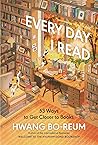
Every Day I Read

Every Day I Read: 53 Ways to Get Closer to BooksEvery Day I Read: 53 Ways to Get Closer to Books 
by Hwang Bo-Reum, translated by Shanna Tan
My rating: 3 of 5 stars (really 3.5)

From the subtitle I was expecting this to be a "tips-and-tricks" book with ideas for enriching your reading life. Had I read the blurb I would have known better. It is actually a collection of very short essays each of which considers a specific aspect of the author's reading life. She talks about the joys and challenges in her reading life and in most essays discusses specific books that she has read that connect for her to the topic being addressed. 

The author is a young Korean woman and a voracious reader. I was charmed and fascinated by this intimate glimpse into her daily life and her views on the books she has read. I was also challenged to consider my own views on the various topics she covers. Reading multiple books at a time; reading "difficult" books; not finishing a book you started; and visiting the library were some of my favorite of her topics.

She is a collector of quotes--I was also when I was young but have fallen out of the habit. Her expanation of what she gets out of the collecting habit has inspired me to go back to it myself. I was also inspired to add quite a few titles to my TBR list.

Here are some of the quotes that spoke to me:
  • "...reading isn't about remembrance but the change that can come from reading a book." (p. 23)
  • "And when I see a particularly insightful quote, I sigh in relief. If I hadn't come across this nugget of wisdom, life might have turned out to be completely different." (p. 78)
  • "I imagine a line of writers holding hands across time and space, If we can understand how the books are connected, we can read with greater depth." (p. 113)
  • "When reading difficult books, have trust in the process and keep going. You'll come to realize no book is too difficult." (p. 197)
This book wasn't what I expected it to be, but it was a fascinating look into the mind and life of a woman living in Korea and finding meaning and guidance in her reading.

Saturday, February 14, 2026

One Hundred Years of Solitude

One Hundred Years of SolitudeOne Hundred Years of Solitude 
by Gabriel García Márquez
My rating: 4 of 5 stars

I listened to this narrated by John Lee which was an excellent choice because there were a lot of Spanish words that I would have stumbled over, including many very similar names. Lee did an excellent job of making the different names clear. He also has a beautiful voice. 
I read this book when I was in college and did not like it at all. Since then I listened to Love in the Time of Cholera which I did enjoy. That inspired me to give this another try and I am glad I did. 
The story is set in the mythical town of Macondo and tells the story of the Buendia family which is intricately intertwined with the history of the town. It starts with this memorable line: 
“Many years later, as he faced the firing squad, Colonel Aureliano Buendía was to remember that distant afternoon when his father took him to discover ice...”
Then weaves through time and various versions of reality to spin a tale of beauty and suffering and love. 
“Wherever they might be they always remember that the past was a lie, that memory has no return, that every spring gone by could never be recovered, and that the wildest and most tenacious love was an ephemeral truth in the end." 
This book is on my Classics Club list.


Saturday, September 21, 2024

Dom Casmurro

Dom CasmurroDom Casmurro 
translation by Helen Caldwell
My rating: 4 of 5 stars

I enjoyed this novel. I discovered Machado de Assis back in college when I read Epitaph for a Small Winner (aka ) for a Latin American Literature class and was immediately a fan. I have read several of his other novels that have been translated to English (unfortunately I can't read Portugese) and have enjoyed all of them. 

The introduction in the edition I read was by Waldo Frank (dated 1952) and he explained that Laurence Sterne was a strong influence on Machado. This makes sense to me as the dry, quiet tone and the way the author steps out of the pages now and then to make asides, is similar. Dom Casmurro is told from the point of view of a man looking back over his life and telling us about it. He hints at the future implications of the events he describes, but until you get there in the story you don't know what happened. This builds a tension in the novel that propels you through it. 
“In ordinary life, the action of a third party does not free the contractor from an obligation; but the advantage of making a contract with heaven is that intentions are valid currency.” --Machado de Assis, Dom Casmurro
This book is on my Classics Club list.


Tuesday, July 5, 2022

Madame Bovary

Madame BovaryMadame Bovary 
by Gustave Flaubert, translated by Lydia Davis
My rating: 3 of 5 stars

This novel is often cited as being one of the greatest novels of all time. It was an early example of realism (think James Joyce and Virginia Woolf). I don't see what makes it so amazing. Emma Bovary was not a like-able character, I didn't even find her to be sympathetic. She is a spoiled, self-centered, fool who makes a mess of the lives of those around her for no reason other than to satisfy her own whims. 
Perhaps at the time of publication (1856) it was so different from what had gone before that it dazzled. The writing was extremely skillful and the action moved quickly. I would go so far as to say this book is a page-turner which is impressive given how much of it is internal thoughts. The translator's introduction supports the notion of innovation as what makes this novel great.
"Yet Proust, in the course of his vehement response, in 1920, to a negative article about Flaubert, commented (admiringly) on what he called Flaubert's 'grammatical singularities,' which, he said, expressed 'a new vision'; our way of seeing external reality was radically changed by Flaubert's 'entirely new and personal use' of the past definite, the past indefinite, the present participle, certain pronouns, and certain prepositions. He went on to talk about other singularities: Flaubert's unprecedented manner of using indirect discourse, his uncoventional handling of the word 'and'--omitting it where one would expect it and inserting it where one would normally not look for it--his emphatically 'flat' use of verbs, and his deliberately heavy placement of adverbs. But it was Flaubert's innovative use of the imperfect tense that most impressed Proust: 'This [use of the] imperfect, so new in literature,' he said, 'completely changes the aspect of things and people.' (p. xix)
This book is on my Classics Club list (it was the selection for the most recent spin) and also counts toward the Back to the Classics Challenge (a classic in translation) and the TBR Pile Challenge. It is one of my 20 Books of Summer.

Thursday, August 28, 2014

Review: Colorless Tsukuru Tazaki and his Years of Pilgrimage

Colorless Tsukuru Tazaki and His Years of PilgrimageColorless Tsukuru Tazaki and His Years of Pilgrimage
by Haruki Murakami

My rating: 4 of 5 stars

I have really liked most of the Murakami I have read, but I was disappointed by 1Q84 (900+ pages and LOTS of unresolved plot lines) so I was a bit nervous about this new book. It turned out to be one of his most approachable, however, and all the threads of the story are reasonably concluded. There is one section which is a bit surreal (it is a story a character tells), so if you like that aspect of Murakami's work there is a little of it, but mostly the action of the story is pretty straightforward.
Like many Murakami novels it is the story of a young man looking back on his earlier life and trying to make sense of where he is now. I liked the character of Tsukuru Tazaki and I thought his interest in (obsession with?) railroad stations was cool and provided a lot of opportunities where the character could watch the world as it moved along and consider his place in it.
For example, the section about the Shinjuku Station:
"During rush hour, that maze transforms into a sea of humanity, a sea that foams up, rages, and roars as it surges toward the entrances and exits. Streams of people changing trains become entangled, giving rise to dangerous, swirling whirlpools. No prophet, no matter how righteous, could part that fierce turbulent sea. It's hard to believe that every morning and evening, five days a week, this overwhelming crush of human beings is dealt with efficiently, without any major problems, by a staff of station employees that no one would ever accuse of being adequate, in terms of numbers, to the task." (p. 360-1)
The hardcover edition of the book (which I got from my public library) was designed by Chip Kidd and is really beautiful.
If you want more Murakami madness there was a recent episode of Books on the Nightstand about the release of this book and Brona's Books had a post that includes a link to the piece of music in the novel.


Sunday, May 11, 2014

Review: Norwegian Wood

Norwegian WoodNorwegian Wood by Haruki Murakami
translated from Japanese by Jay Rubin
My rating: 4 of 5 stars
"All of us (by which I mean all of us, both normal and not-so-normal) are imperfect human beings living in an imperfect world, We don't live with the mechanical precision of a bank account or by measuring all our lines and angles with rulers and protractors." (p. 355)
This novel was different from other Murakami I have read in that it was more grounded in reality. It was philosophical and beautifully written which is typical of Murakami. The story follows the life of a young man at University, Watanabe, as he figures out who he is and what his responsibility to others is. He is a rather odd, but I thought very appealing, young man and his conflicts and observations were thoughtful and made me think about larger questions along with him. I found it a bit strange that the music he listens to (the story takes place in Japan, mostly Tokyo, in the late 1960s) was all English-language music (John Coltrane, the Beatles, Bach, etc.). The song Norwegian Wood is a recurring theme.

If you haven't read Haruki Murakami this would be an easy book to start with as it is a more straightforward narrative than some of his books. Don't stop with this one though, as it isn't representative of the amazing work Murakami has produced.